The Oracle Australia and New Zealand Middleware and Technology Blog.
Showing posts sorted by relevance for query twitter. Sort by date Show all posts

Monday, September 15, 2008

Oracle Openworld just around the Corner!

Oracle Openworld opens in San Francisco on Sunday 21st September.

Details of all the Keynotes can be found here and those not able to travel to the US for the show will be able to watch keynotes by Larry Ellison, Charles Phillips, Thomas Kurian, Paul Otellini and Mark Hurd among others will play live on the web but will also be archived for later viewing.

Note in particular that James Carville - the election strategist credited with Bill Clinton election success in 1992, will be opening the conference on Sunday evening.

For those heading out to San Francisco next week, the following ANZ presentations will be worth attending:

  • West Australian Dept of Educ (WADET) speaking on the use of Oracle L360 for 800 schools across 2.5m kms - 24th September at 1pm at Westin hotel.
  • Australian Oracle ACEs and bloggers Chris Muir and Marcel Kratochvil presenting at the Openworld Unconference on "ADF Methodology" and "Using PL/SQL Conditional Compilation" respectively on wednesday 24th September at 9am (Overlook I and II) in The Moscone Centre, Level 4
  • Australian Oracle Certified Partner, Seertech, is presenting on "BPO: Beyond the Obvious" on Tuesday 23rd September at 12.30pm in Moscone West Room 3018 and also on "Learning Management Outsourcing" Wednesday September 24th at 5pm Moscone West Rm 3018
  • Newly arrived Oracle ACE and blogger Alex Gorbachev presenting on "Under the Hood of Oracle Clusterware" on Monday 22nd September

For those not attending, the following online assets will help you get the most from the show fromn the comfort of your desk:

1. Openworld Twitter Feed
2. ANZ Openworld Twitter Feed
(Twitter users will be able to follow all discussion around Openworld by searching Twitter search - http://search.twitter.com/- for #openworld08)
3. Openworld @ YouTube:
4. Openworld Blog
5. Openworld Home page

Watch this space for more news and highlights as the show unfolds next week!

Friday, March 13, 2009

First thoughts on the Oracle Database Machine in Australia

Well its been a little over 4 months now since i started been involved with the Oracle Database Machine or DBM as i will call it here. The DBM is Oracle's first foray into the hardware appliance market.

In this tough economic climate its no surprise that every organisation wants to drive cost out of the business, in the front end and especially at the back end. The DBM couldn't have arrived at a better time to the market for our customers, here is an appliance datawarehouse designed for massive throughput from loading data, executing queries and presenting the important business intelligence back to the business. Speed in everything is essential but speed alone doesn't reduce costs, the real value in the DBM is the fact its an appliance. This is underrated IMHO especially now in this economic cliamate.

This week i needed to re image my laptop, Oracle gives you the option of Linux or Windows and being a secret techno i thought i would give Linux a try. Now i used to dabble in Unix but it was 20 years ago, and i was hoping not to venture near the text based utility vi. Anyway Linux did install pretty easy, actually i was surprised but then when i wanted to tailor it with dual head display, tool bars, gadgets, desktop search and adobe air for tweekdeck (the coolest twitter app) i suddenly realised all is not what it seemed. Suddenly i was thrust upon with desperate searches to see how to install RPM/BIN and remembering syntax for commands that mean nothing to me like chmod, bash and sudo. Wow i cant tell you how many hours i have sat at home getting this just right. Its hard since building Linux desktops isn't my profession so i wasted a lot of time taking in the knowledge of configuring a Linux.

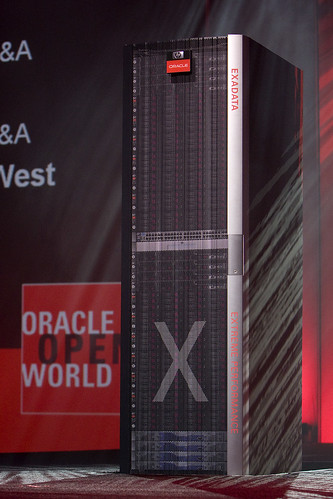
This now takes me back to the appliance concept and specifically the DBM. Customers initially look at this box and dont appreciate the sum of the parts is far greater than any bill of materials can suggest. The DBM contains 8xHP DL360's, 14 Exadata Storage Cells with 12 disk in each, Infiniband,Oracle Unbreakable Linux, Enterprise Edition Database, RAC and Partitioning. So if you wanted an new warehouse and went to the effort of procuring the hardware, software and then looked and building the hardware units, loading drivers, os, database, RAC and ensuring its all up to date you are talking abut serious hours here. And in reality for most organisations its months not hours because your never going to dedicate resourcing 100%.

In these economic times we need to look at efficiency and productivity closer than ever. IT departments are there to make sure the user community and the business have the tools at their disposal to be productive, to automate repeatable processes and build a secure and compliant infrastructure. Its such a drain on resources to build a linux desktop as in my case or to procure a crate of hardware and a library of software to build something when you can just plug in an appliance.

The DBM offers great value when you consider Oracle with HP has done all this work for you, you can then focus on getting the most out of your new datawarehouse with new queries for the business, better ETL performance and headroom to cover the expected growth when the world recovers.

So today i have just touched on the appliance value of the Database Machine, over the next few weeks i will look at what really makes this box scream. The "Secret Sauce" will be my next post when i will discuss how the Storage Cells in the Database Machine are accelerating customers queries by factors over x100 times.


The Oracle Database Machine

Wednesday, December 24, 2008

the red room review for 2008

The red room was founded for several reasons, to communicate with Oracle customers and the general IT community was one. But to make this communication more interesting we wanted to explore how new WEB 2.0 technologies could assist. Could these largely social utilities add any value for Oracle, our readership and our customers?

The answer is a resounding yes. Technologies that worked very well included Twitter with live feeds from Oracle Open World OOW08, Linkedin to participate in group discussions around areas like security and compliance, and the content hosting sites like iTunes, Podbean and Scribd.

Sure these sites would enrich the experience on the red room for our readers. The real bonus is that each of these technologies has their own unique communities to tap into. For example the red room had over 5,000 visits from July this year, scribd which hosts our presentations had over 2,500 views from scribd users. So you see we reached potentially another 2,500 readers by placing the content in multiple sites and 632 people downloaded a podcasts from podbean.

Our readership includes 50% from Australia and New Zealand which validates that people are interested in reading localised content and not just from news from the USA. Other countries include France, Turkey, Japan, Italy and Spain (i need a field trip) with 74 countries in all.

The Oracle news highlights for me this year included the acquisition of BEA and Oracles first hardware appliance The Database Machine.

Our top 5 articles this year

1.       SOA or Not

2.       Unstructured Information Management

3.       Australian Federal Government and WEB2.0

4.       Oracle Role Management

5.       Oracle Universal Archive

Other notable articles include

·         The Clumsy Human PT 1&2

·         Open World Final Day and the Joy of X

·         Oracle and BEA – Full Circle

·         iPhone and its impact on Information Management

·         Have your ignored PCI

In 2009 we will have more contributors including a 10 posts series on SOA Governance. Look our for our new years eve posts from Paul Ricketts for more on this and what the future will hold for the red room in 2009.

Its time i bid you farewell, presents to wrap and no doubt a cold beer also. Have a joyous holiday with your friends and family, try and avoid the news so you can rest and recharge for what will be an interesting 2009.

Cheers

Carl


Wednesday, June 3, 2009

Oracle/BEA: 12 months on.

I saw this headline recently in a 2003 article from Mining Journal and I thought it was great, "Some years, 12 months can seem like long time." (You may well ask why I was reading 6 year old back issues of Mining Journal but I'm sure you've all been in a dentists waiting room). Some years 12 months can indeed seem like a long time... but not this one, well, not for me anyway.

I really enjoyed reading this article from my friend Chris Duckett - OK, so I follow him on twitter, that means I can say he's my friend doesn't it? - on the Oracle/BEA acquisition 12 months on.

We get so caught up in the 'what if's?' in our industry that it's really good to take time out and look back at the 'what happeneds'. 12 months ago we were full of what if? Two major middleware product sets were coming together, what would survive and what would perish? And what did perish actually mean? Would Oracle force a BEA customer to move to an Oracle product? How would BEA products be supported? What would the future product strategy look like?

My summary is that the reality of the acquisition was nowhere near as doom-laden with grave concerns some had predicted. There were no forced migrations, in fact products that didn't make it front and centre into the plans for the future are still being enhanced and supported, as Derrick Wheeler says in Chris's piece, "
We were concerned about WebLogic Integration a little bit as to where that would fit... We've since been assured that we can purchase more licences and that we'll be supported — at least five years developed, another five years supported — that makes us feel more comfortable."

There were decisions about the product roadmap that needed to be taken, as Cameron Tuesly from Integral Technology Services says in the article, "
There was a few overlapping products, I have to say that I thought Oracle did a pretty good job of clarifying early on where they were going... I think they picked the right products, where there were two products they seemed to have picked the stronger one rather than the incumbent."

And there is some evidence that the whole is greater than the sum of its parts in these acquisitions, a sort of 2 + 2 = 5, in that the organisation is able to turn its big brains loose on new and innovative ways to combine some of the products together. Case in point here is the WebLogic Application Grid. Oracle had Coherence, BEA had JRockit... to use a catchphrase, "Will it blend?" Well, turns out they blended very well - without the dust, smoke and general destruction that our good friends at Blendtec will show you if you click on that last link.

Coherence is a highly clustered, highly fault tolerant in memory data cache
, JRockit is the fastest Java Virtual Machine in the world. Mix them together, add some management and operations control and you have the WebLogic Application Grid, bringing maximum performance, scalability, predictability and reliability on commodity hardware to Java applications.

So good on you Chris for taking a moment to reflect and examine what actually happened. I liked this quote from Chris Muir as I imagine a future 12 months from now, "... they are accumulating some of the best products in the world". That sounds good to me, working with some of the best products in the world.

-sean

Friday, August 29, 2008

Can IT beat the clumsy human pt1


One of the greatest challenges is securing data, especially for some reason data that contains information on people. It’s almost like personal data morphs into the people it represents and wants to break free of the constraints placed upon it within the database and applications. When you look at how many ways data can escape these constraints you often wonder is it possible to protect from humans from assisting in data breaches.

So let’s have a quick look at what can go wrong;

“Export” could be the greatest contributor to data breaches ever. How many people use this luxurious command to get data into excel so they can massage it with pivot tables. Now the clumsy human is a simple being so files are often labelled like “first half year forecasts” or “details of registered guests”. Once this data is exported from the confines of a structured data store and let loose in the unstructured world there is little that can be done.

“WEB2.0” have you noticed how easy it is these days to share files across the internet via social network sites, cloud computing, software as a service, online storage, instant message ect. Indeed except for twitter almost every other WEB2.0 technology is a haven for moving data. For the clumsy human it’s all too easy to store data somewhere in the cloud for convenience and backup assurance.

“eBay” unfortunately shows these clumsy humans like nothing else. Only last week it was revealed a poor and i suspect now unemployed individual sold a work PC via ebay that contained private customer data. Regardless what process’s are in place the clumsy human needs to follow them. Do we insist all devices with a hard disk be destroyed via some huge cheese grater when decommissioned? – Probably.

“Smartphones” are again a great leveller when it comes to corporate security. Almost everyone has a phone with at least 256MB of RAM. This amount of RAM seems small these days, but 100MB can store several volumes of an encyclopaedia. Or 1000’s of contact details. With email synchronisation being more common now, again the clumsy human doesn’t have a chance.

See part 2 of the clumsy human for some recomendations