Well its been a little over 4 months now since i started been involved with the Oracle Database Machine or DBM as i will call it here. The DBM is Oracle's first foray into the hardware appliance market.
In this tough economic climate its no surprise that every organisation wants to drive cost out of the business, in the front end and especially at the back end. The DBM couldn't have arrived at a better time to the market for our customers, here is an appliance datawarehouse designed for massive throughput from loading data, executing queries and presenting the important business intelligence back to the business. Speed in everything is essential but speed alone doesn't reduce costs, the real value in the DBM is the fact its an appliance. This is underrated IMHO especially now in this economic cliamate.
This week i needed to re image my laptop, Oracle gives you the option of Linux or Windows and being a secret techno i thought i would give Linux a try. Now i used to dabble in Unix but it was 20 years ago, and i was hoping not to venture near the text based utility vi. Anyway Linux did install pretty easy, actually i was surprised but then when i wanted to tailor it with dual head display, tool bars, gadgets, desktop search and adobe air for tweekdeck (the coolest twitter app) i suddenly realised all is not what it seemed. Suddenly i was thrust upon with desperate searches to see how to install RPM/BIN and remembering syntax for commands that mean nothing to me like chmod, bash and sudo. Wow i cant tell you how many hours i have sat at home getting this just right. Its hard since building Linux desktops isn't my profession so i wasted a lot of time taking in the knowledge of configuring a Linux.
This now takes me back to the appliance concept and specifically the DBM. Customers initially look at this box and dont appreciate the sum of the parts is far greater than any bill of materials can suggest. The DBM contains 8xHP DL360's, 14 Exadata Storage Cells with 12 disk in each, Infiniband,Oracle Unbreakable Linux, Enterprise Edition Database, RAC and Partitioning. So if you wanted an new warehouse and went to the effort of procuring the hardware, software and then looked and building the hardware units, loading drivers, os, database, RAC and ensuring its all up to date you are talking abut serious hours here. And in reality for most organisations its months not hours because your never going to dedicate resourcing 100%.
In these economic times we need to look at efficiency and productivity closer than ever. IT departments are there to make sure the user community and the business have the tools at their disposal to be productive, to automate repeatable processes and build a secure and compliant infrastructure. Its such a drain on resources to build a linux desktop as in my case or to procure a crate of hardware and a library of software to build something when you can just plug in an appliance.
The DBM offers great value when you consider Oracle with HP has done all this work for you, you can then focus on getting the most out of your new datawarehouse with new queries for the business, better ETL performance and headroom to cover the expected growth when the world recovers.
So today i have just touched on the appliance value of the Database Machine, over the next few weeks i will look at what really makes this box scream. The "Secret Sauce" will be my next post when i will discuss how the Storage Cells in the Database Machine are accelerating customers queries by factors over x100 times.

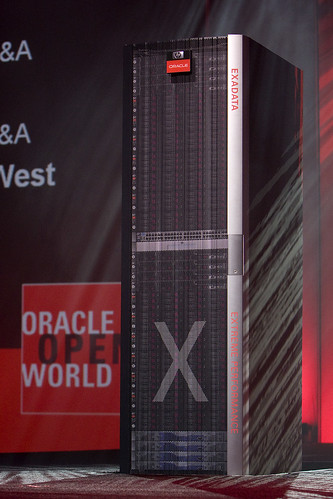
The Oracle Database Machine
In this tough economic climate its no surprise that every organisation wants to drive cost out of the business, in the front end and especially at the back end. The DBM couldn't have arrived at a better time to the market for our customers, here is an appliance datawarehouse designed for massive throughput from loading data, executing queries and presenting the important business intelligence back to the business. Speed in everything is essential but speed alone doesn't reduce costs, the real value in the DBM is the fact its an appliance. This is underrated IMHO especially now in this economic cliamate.
This week i needed to re image my laptop, Oracle gives you the option of Linux or Windows and being a secret techno i thought i would give Linux a try. Now i used to dabble in Unix but it was 20 years ago, and i was hoping not to venture near the text based utility vi. Anyway Linux did install pretty easy, actually i was surprised but then when i wanted to tailor it with dual head display, tool bars, gadgets, desktop search and adobe air for tweekdeck (the coolest twitter app) i suddenly realised all is not what it seemed. Suddenly i was thrust upon with desperate searches to see how to install RPM/BIN and remembering syntax for commands that mean nothing to me like chmod, bash and sudo. Wow i cant tell you how many hours i have sat at home getting this just right. Its hard since building Linux desktops isn't my profession so i wasted a lot of time taking in the knowledge of configuring a Linux.
This now takes me back to the appliance concept and specifically the DBM. Customers initially look at this box and dont appreciate the sum of the parts is far greater than any bill of materials can suggest. The DBM contains 8xHP DL360's, 14 Exadata Storage Cells with 12 disk in each, Infiniband,Oracle Unbreakable Linux, Enterprise Edition Database, RAC and Partitioning. So if you wanted an new warehouse and went to the effort of procuring the hardware, software and then looked and building the hardware units, loading drivers, os, database, RAC and ensuring its all up to date you are talking abut serious hours here. And in reality for most organisations its months not hours because your never going to dedicate resourcing 100%.
In these economic times we need to look at efficiency and productivity closer than ever. IT departments are there to make sure the user community and the business have the tools at their disposal to be productive, to automate repeatable processes and build a secure and compliant infrastructure. Its such a drain on resources to build a linux desktop as in my case or to procure a crate of hardware and a library of software to build something when you can just plug in an appliance.
The DBM offers great value when you consider Oracle with HP has done all this work for you, you can then focus on getting the most out of your new datawarehouse with new queries for the business, better ETL performance and headroom to cover the expected growth when the world recovers.
So today i have just touched on the appliance value of the Database Machine, over the next few weeks i will look at what really makes this box scream. The "Secret Sauce" will be my next post when i will discuss how the Storage Cells in the Database Machine are accelerating customers queries by factors over x100 times.
The Oracle Database Machine